
Freedom
America has always meant Freedom (or Liberty, which means (more or less) the same thing to people all over the World. We even have a gigantic Statue of “Liberty Enlightening the World” facing outward from our busiest harbor.
Yet the Founders of our Nation, gathering together to draw up a Constitution, had to face the embarrassing fact that a system of Slavery prevailed in many of the new States. Even worse, that system was racially based.
The word “freedom” does not occur in the Constitution or in any of its amendments. However the noun “Right” does occur throughout the first ten amendments, which collectively are known as the “Bill of Rights.”
Most of the Amendments which have been made to the Constitution enlarge freedom in various ways. However, there was one amendment which actually did the opposite. It deprived many people of a freedom which they had always assumed they possessed. This was the notorious Eighteenth Amendment (1920), which ushered in the Era of Prohibition.
There are some remarkable facts about that entire historical episode. In the US, it was generally considered, until then, that the hardest piece of legislation to get passed into law would be a Constitutional Amendment. Furthermore, once actually approved by the required number of legislatures, any such amendment would be among the hardest to get rescinded. Yet, in the case of Prohibition, the time which elapsed between its approval by Congress and becoming Law, and its being repealed by large majorities all over the country, was only 13 years.
But it was another decade before President Franklin Delano Roosevelt (“FDR”) gave a famous speech before Congress in which he enunciated Four Freedoms which should prevail as a goal throughout the World. It was a “State of the Union” address, which is required by the Constitution to be given “from time to time.” This particular time was Monday, January 6, 1941. World War II had already been raging for over a year, but the U.S. would not become directly involved until nearly the end of that year. We had, however, been indirectly involved for many months, with a system called “Lend-Lease,” which enabled American aid to be supplied to a Britain badly in need of such help.
The Four Freedoms were, specifically, what we might call two positives and two negatives. The positives were Freedom of Speech and Freedom of Religion. The other two were Freedom from Want and Freedom from Fear. Coming from the American President, they naturally received very wide publicity. This was aided by a series of four special paintings by the famous painter, Norman Rockwell, whose art was already very well known, from its frequent appearance on the cover of what was probably that day’s most widely circulated weekly magazine, the Saturday Evening Post. Those paintings, in turn, found their way onto such national media as Postage Stamps. In particular, Rockwell’s illustration for “Freedom from Fear” lingers in my mind. It showed presumably American parents standing at the bedside of two sleeping children. The father is holding a newspaper on which the headline can be seen to refer to some war horror, no doubt far away.
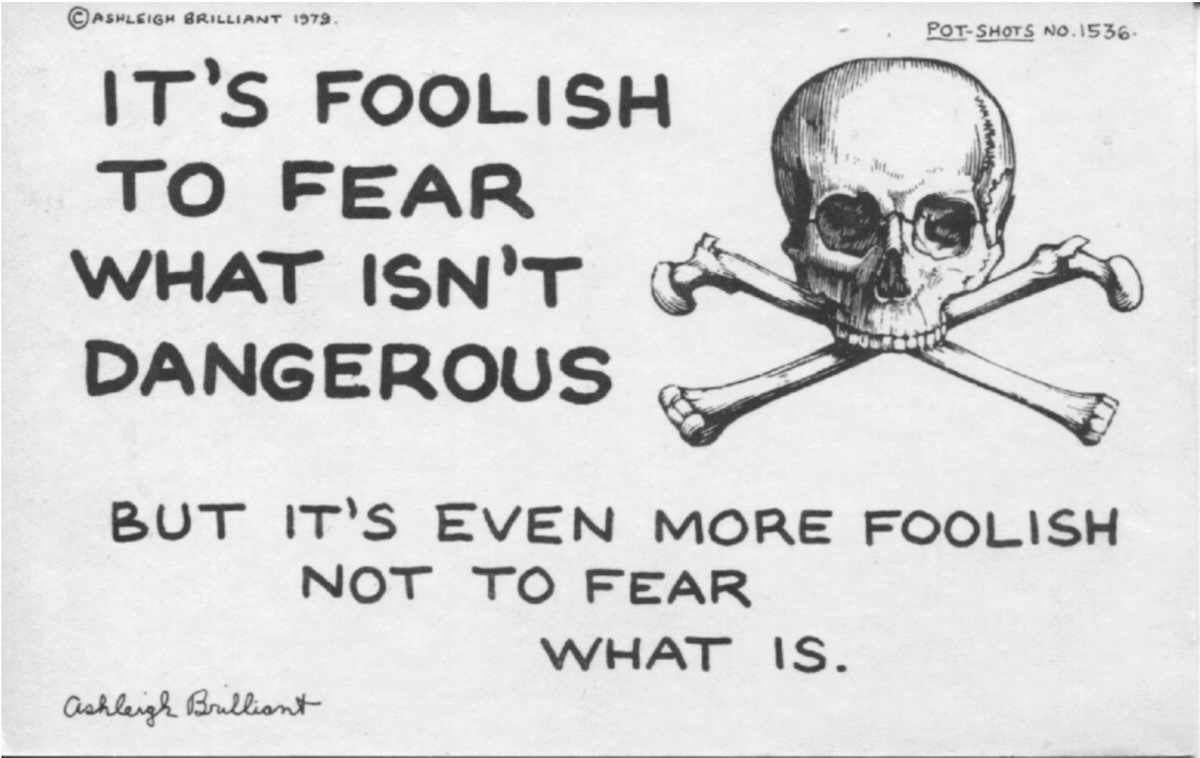
Ironically, since those far-off days, new perils have emerged which people of that generation knew nothing about. One thinks of new diseases like AIDS and Covid, or mass shootings, which seem to have become so common that they hardly make headlines. But gun owners cherish their right, guaranteed under the Second Amendment to the Constitution, “to keep and bear arms.” There aren’t many other “civilized” countries whose basic laws give so much protection to dangerous weaponry. However, it must be said that at least one of those countries – the notoriously peaceful nation of Switzerland – practically requires every householder to maintain, and keep accessible, some kind of high-powered firearm. I suppose this can be understood simply from that country’s geographical position, surrounded by perpetually warring nations.
One of the most famous quotations on this subject says that “The price of liberty is eternal vigilance.” Unfortunately, that word “vigilance” has inspired various groups to take the law into their own hands, to call themselves Vigilantes” – a word commonly used after the Civil War to describe groups whose purpose was to terrorize ex-slaves
And today other groups like to assert that “Freedom Is Not Free.” But we might prefer to conclude with the story told in Born Free, of the lion cub adopted and raised by white settlers in Kenya, and then successfully released into the wild.
You might also be interested in...



