
Finding Relief in History
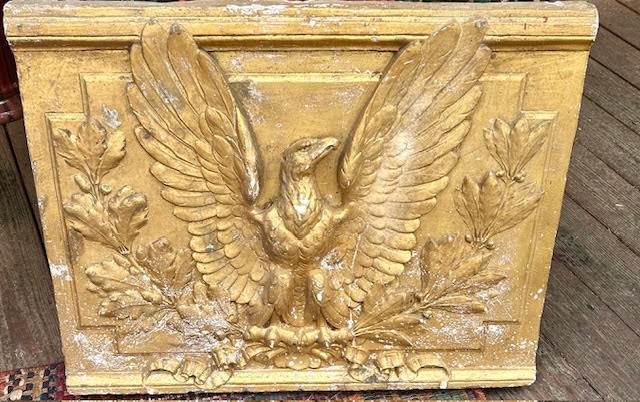
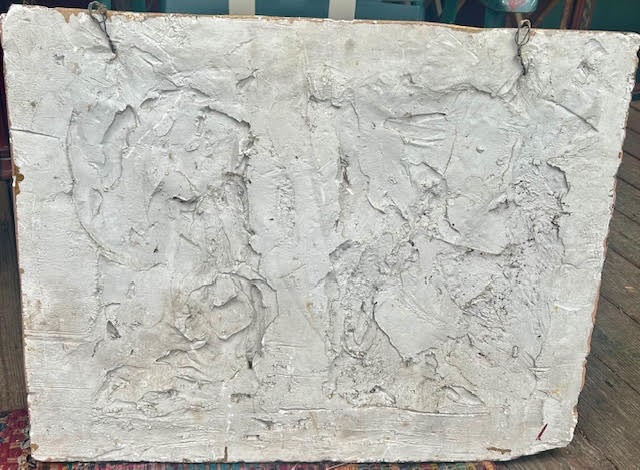
KC sends me a “relief” image of an eagle (a relief is a three-dimensional image), a work created out of plaster; a plaque boxed in the image on three sides, at 17”x28”. KC writes that this was found in the basement of an antique dealer years ago.
Instead of the typical spread-wing eagle associated with American iconography, KC’s eagle has its wings pointing straight up, similar to those used in Roman Classical design. Instead of the typical American symbols of the olive branch in the right (dexter) talon, and arrows in the left (sinister) talon, this eagle has the olive branch in the sinister and an oak branch in the dexter talon. [Dexter and sinister are heraldic terms describing the exact location(s) of various features in a coat of arms.] American bald eagles on coins, on the Great Seal (designed in 1782), on architecture, and on Federal furniture feature a (stars and stripes) shield over the eagle’s breast.
KC’s eagle IS DIFFERENT. What is the origin of this eagle? Where was it used? When was it created?
The key to KC’s eagle is the symbol of the eagle itself, representing kings, power, and the status quo, which goes back to Greek mythology in the eagle of Zeus. In the later Roman Imperial period, the symbol of Jupiter, the King of the Gods, was his eagle – which also represented Jupiter’s messenger, or incarnation. Charles Thomson, American Secretary of the Continental Congress in 1782, modified this Classical eagle iconography to feature the Bald Eagle, a true American native species, for the Great Seal.
The history of animal images used as symbols of greatness and strength are found in many mythologies: I have mentioned the eagles of Zeus and Jupiter; there’s the Ibis of Thoth in Egyptian culture, and in Hinduism there’s the divine king of the birds, Garuda, and Ganesha, the God with the elephant head.
Animals symbolize certain attributes, and the eagle has been understood for millennia to represent kingship, dominion, strength, power, wealth and majesty. In the 17th and 18th century, the Eagle represented the power of money, and the symbol was incorporated into money/currency, symbolizing financial power and used in a family crest (heraldry). In Europe and America, eagle images were incorporated into architecture that represented national wealth, family wealth, and banking.
KC’s eagle, with its oak and olive branches, most resembles eagles associated with banking and financial institutions (and imprinted into currency). The symbol of the oak tree represents strength and solidity. The olive branch symbolizes peace. When associated with money, the images mean wealth and stability.
The American dime of the late 19th century features both the olive and the oak branch – although these two symbols are not paired with an eagle, but with a torch on our 10-cent coin; the olive branch is seen on the left of the torch.
I found a similar eagle – featuring an olive and oak branch and upright wings in the Roman style – on French and American architecture and objects associated with banking of the 19th century. For example, the American dime designed in 1874 features both the oak and the olive branches, and French banks of the period bore emblems of both the oak and the olive branches, with or without an eagle symbol.
The eagle of French monetary symbolism and the eagle of American monetary symbolism are close cousins. When our young country was debating the U.S. National Bank as an institution to be established (1789-1801) by Congress during the Federal Period, French and American finances were closely associated – for good and bad, for profit and debt. The U.S. had borrowed greatly from France during the American Revolution. When France demanded that debt repaid, the debate over banking and national debt raged between American French supporters and isolationists.
It was only in 1795 that the U.S. settled its French debt, and though the U.S. National Bank had been established in 1791, the U.S./French debt settlement was privatized by an American financier and did not involve the National Bank.
The fact that KC’s eagle was designed in relief on plaster means that this plaque was part of a wall or a building and thus likely incorporated into architecture, perhaps as an emblem on a bank. I would surmise that it was not created for an American bank. Plaster was used for exterior decorative elements throughout the 19th century, and I would assume this to have been created in the mid to late 19th century with a European origin.
KC, I can’t give you a value on this plaque, but I postulate $500-ish. We have uncovered these details – it is most likely French, it is associated with banking, it was part of a structure as a decorative object, and it symbolized solidity and power and stability.
You might also be interested in...




You must be logged in to post a comment.