
The Fantastical Maxfield Parrish
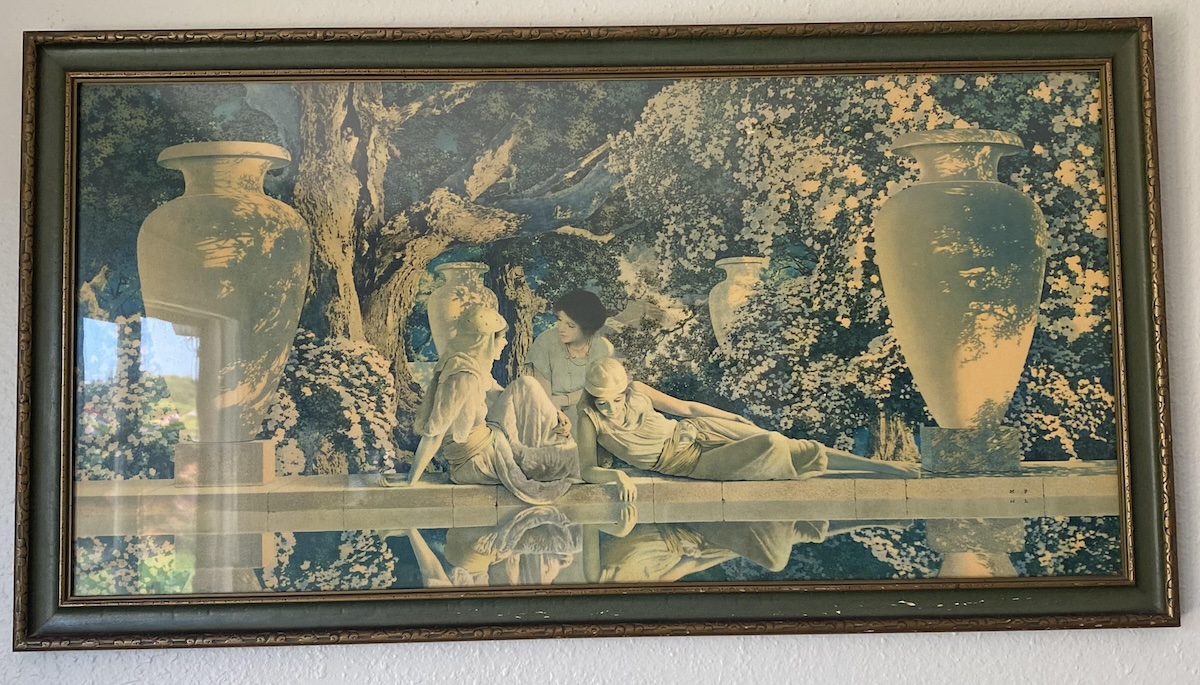
What does fantastic exotic art have to do with DC, who grew up in a Pedregosa Street 1900s home in Santa Barbara? From the early 1970s, she and her brother were enchanted by two prints by Maxfield Parrish; The Lute Players (1924), and The Garden of Allah (1918). I’d like to explain the themes and why, in the 1970s, DC fell in love with works that were created in the first quarter of the 20th century.
Equally exotic titles her parents might have owned (and I will analyze a few of these) stem from a treasured myth:
Circe’s Palace
Jason and the Talking Oak
Altas and The Universe
The Landing of the Brazen Prince (Prince Agib)
Queen Gulnare of the Seas
The Young King of the Black Isles
Maxfield Parrish (1870-1966) was an American Quaker and master of the fantastic. Creator of a commercial style that was also recognized as fine art, Parrish was a book and magazine illustrator in great demand, an advertising man, innovator of a color ultimately known as “Parrish Blue,” and one of the most popular artists of the 20th century. In 1936, Time magazine wrote that – using the measure of fine art reproduction sales – the American public’s three most popular artists at that moment were Cezanne, Van Gogh, and Parrish.
Let’s take a few of these titles and see why the American public, like DC, became enchanted with Parrish, and why his illustrations became instant reproducible works. Parrish’s alluring piece Circe’s Palace (1907) is based on Nathaniel Hawthorne’s early 19th century story of that name, which retells the Greek myth of the witch Circe in Homer’s Odyssey. In the story, Circe beguiles passing sailors, trapping them on her island, feeding them a magic elixir, and transforming them into swine. The story is filled with repressed desire, lust, loss of self – and exotic faraway places, as well as lots of blue sky and blue sea as well. The story is replete with beautiful, half-naked nymphs and youths in shirtless togas, too. Maybe not always togas; sometimes kilts, harem pants, loincloths, as Parrish set the scene for the imagination of the early 20th century…
Americans’ dreams were crowded with Dark Eyed Persian Princes, Bearded Egyptian sorcerers, and stoically handsome Native American braves. I remember my grandmother, Ruth Sophia in St. Louis, singing the “Pretty Red Wing” song (she was 20 years old when Parrish was becoming the rage). “Oh the Moon shines tonight on pretty Red Wing” as she waits for her Brave…
Another famous illustration was the gigantic Atlas by Parrish (1908), the Greek titan holding up the heavens in the form of that Parrish Blue sky and high atmospheric clouds. Atlas bears the weight of the world as a punishment for having fought against the Olympians in the decade-long Battle of the Gods. Of course he is handsome, showing off a beautiful strongman physique; the envy of any young scrawny American farm boy.
The title that might have intrigued DC growing up in seaside Santa Barbara, Parrish’s Queen Gulnare of the Sea (1909) takes its title from a story in One Thousand and One Nights, the 8th century collection of middle eastern folklore. In the story, a beautiful sea creature washed up on the shores of Persia and is discovered there by the handsomest King Hamid. The king falls in love with her even though she can’t speak. Parrish’s image captures the sorcery and enchantment that infuse the ancient story.
Jason and the Talking Oak (1910) is modeled after Parrish’s own home in New Hampshire, “The Oaks.” His piece features a robed youth amid towering tree trunks, where he is seeking advice on love – a myth that joins man and nature at a pivotal time in history before WWI.
The Landing of the Brazen Boatman (1907) is a tale of a young prince in love with a princess, and his travels over water to her father’s palace. With intrinsic themes of escapism, sex, and lust, the work piqued the interest of a generation of Americans who may never have visited a museum.
Not only was Parrish a great addition to any wall, but he was also a great addition to any bookshelf. A talented illustrator, he published Arabian Nights: Their Best-known Tales in 1909, and in 1910 Nathanial Hawthorne’s A Wonder Book and Tanglewood Tales, The Golden Treasury of Songs and Lyrics, and The Poems of Childhood. Magazines hired him, Colliers’ and Hearst’s, and even tire companies sought his illustrations. When the ad trade began to fizzle, Parrish signed deals for promotional calendars with General Electric and Edison Mazda Lamps, painting themes of nude figures in elysian surroundings.
DC asked if the two prints in her possession were of any value. The answer? ONLY if those two were vibrant, uncirculated, and not previously displayed printer’s proofs. So many Parrish images were reproduced that unless you have a printer’s proof or – how unlikely – an original watercolor, the prints are worth about $200.
You might also be interested in...



