
Cares
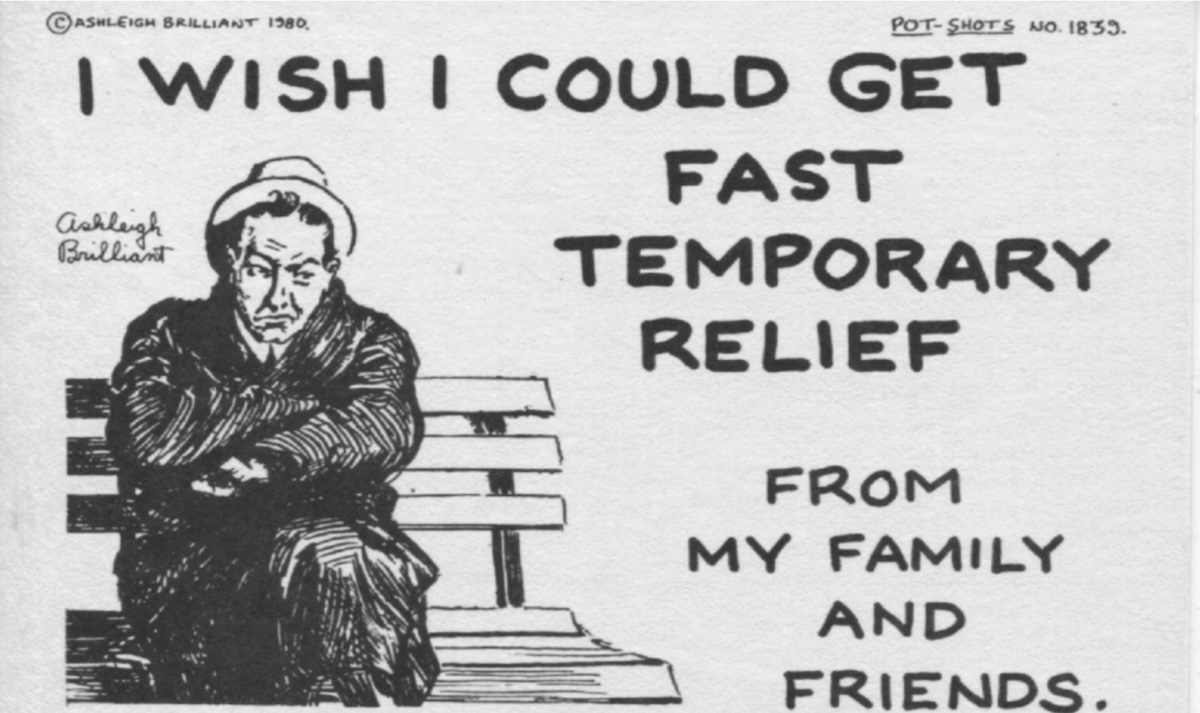
Looking back on my life, what do I regret? Quite honestly, I don’t even think in those terms. The Past is over, and there’s no point in having second thoughts about it. Did I make any wrong decisions? Should I be sorry for mistakes I’ve made, for people I’ve hurt, for exercising bad judgment (something I was more than once accused of)? My answer to all such questions is: WHO CARES? As I wrote not long ago in one of my Brilliant Thoughts – “The secret of happiness is: Not Caring.”
I can already hear a chorus of protests: Surely, the essence of humanity is caring about how people think, and feel, and behave. I am reminded of an old English folksong about a “Jolly Miller” who lived and worked beside the River Dee. Presumably, the work in his mill consisted of grinding grain between two large millstones, which reduced it to a powdery consistency capable of being eaten, or first cooked, or fed to horses or oxen. The song tells us that this work kept him busy “from morn till night,” but, rather than being tired or depressed, there was “none so blithe as he.” And what was his secret? As the song quotes him:
“I care for nobody – No, not I – And nobody cares for me.”
Considering that I learned this song, and sang it, at school, I don’t know what that says about the British education system.
But there were other songs of around the same vintage, which we also learned and sang. One that has stuck in my mind counseled, “Begone Dull Care,” when the word “dull” obviously had much of the sharpness which it has since lost. It went on to say that “Too much care can make a young man go grey,” and can “turn an old man to clay.”
And of course there were, and are, many other words for care. One of the most popular, especially down in the Antipodes, is worry. “No worries” is very common Aussie lingo and can be emphasized with various additions. I remember first hearing one of them when I was in the process of renting a car in New Zealand. That country, as you may know, consists mainly of two large islands, having the romantic names of “North Island” and “South Island.” Their primary connection is a ferry-boat service, which carries both cars and people. I was on my first visit, and traveling by myself, and wanted to drive around both islands. At the car-rental office on the North Island, I couldn’t help revealing how much anxiety I was feeling about this whole adventure. It was there that the man in charge said to me those comforting words, “No worries, mate – not a worry in the world.”
Here, in our part of the worry-world, one expressive ditty, with its own measure of comfort, says repeatedly that “It takes a worried man to sing a worried song,” but it concludes by saying “I’m worried now – But I won’t be worried long.”
Such cheerful musical thoughts are of course particularly prevalent in wartime. In World War I, the message was to “Pack up your troubles in your old kit bag, and smile, smile, smile!” And, since those were days when practically every soldier smoked, the song could add “While you’ve a lucifer to light your fag.” (Lucifer began as a brand name for a particular type of boxed matches, then devolved into slang for any type of match.) With our modern medical knowledge, one cannot help speculating how many deaths, miles and years from the battlefields, were ultimately caused by those same fags – the mid-20th century slang for “cigarette.”
But the Lucifer story also reminds me of another world epic, the true story of Ivar Kreuger, who became known as the Swedish Match King. Between the two World Wars, he did indeed come to control a major proportion of match production in the entire world. In those days, when you bought a pack of cigarettes, it often came with a free box of matches. This was before the popularity of the now much more common folding “match-books.” But in either case, what really mattered, from a world business point of view, was the fact that these containers also provided highly visible, and commercially lucrative, surfaces for advertising.
Speaking of which, and returning to our theme – let us pay tribute to MAD Magazine, which, since 1953, popularized a character with a silly grin named Alfred E. Neuman and the accompanying caption “WHAT, ME WORRY?”
You might also be interested in...



