
Tarotpy 101: When Psychotherapy and Divination Meet
The first time I got a Tarot reading, it was a quick disaster. My amateur fortune teller friend pulled a card from the deck, and immediately mumbled: “Better not show him this one.” Surely it was illustrating imminent death and endless suffering. Which was all I needed to know that Tarot was not my cup of tea leaf reading.
However, the night I met Lauren Schneider, MA, MFT, was not like any other night.
I met Lauren in line outside SBIFF’s Downtown Film Center. She was with her husband, Sascha Schneider, and through our conversation I learned she was a psychotherapist with a background in film semiotics, and had a therapy practice that specialized in using Tarot cards. Tarotpy, she cleverly coined it (think “therapy” without the h”…). On another evening at any other time in my life, I would have engaged in polite conversation and gone on my way, chalking up anything to do with Tarot to be too woo-woo for my taste.
But a confluence of events led me to be uniquely primed for this meeting. Suffice to say, I was in “looking for answers mode” contemplating existential questions about life and death, digesting doctor visits, dabbling with meditation, and mourning the late David Lynch. You know, your typical Thursday night things.
I learned that Lauren’s husband, Sascha, was a producer for the groundbreaking cop series Hill Street Blues, a show that coincidentally Mark Frost worked on prior to creating Twin Peaks with David Lynch. Synchronicity in action! My curiosity was piqued. Or was I just another dupe of the Baader-Meinhof phenomenon, easy prey for the frequency illusion? Did it matter? I was intrigued and amused by these coincidences. I let Lauren in on what I was thinking, and she too found it compelling. So, just like that, we scheduled a Tarotpy session.
“We may become aware of synchronicities that respond to our quest for direction. A stranger may hand us a clue or a map to the new path we seek.”
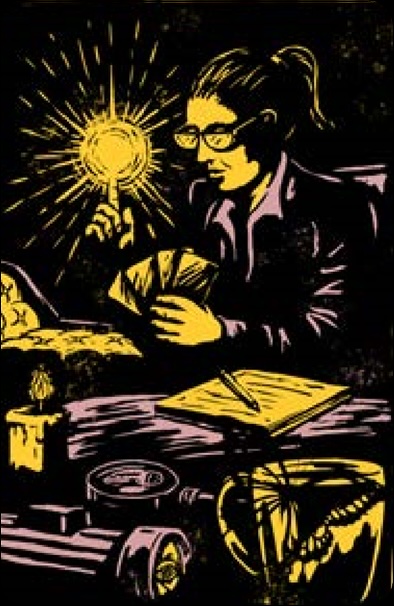
Lauren’s background is infinitely interesting. She studied film semiotics in France in the ‘70s, surrounded by incredibly influential film and cultural theorists. After working in film, she pivoted and got an MA in Marriage and Family Therapy and started dabbling in the mystical.
“I started in ‘83, and I felt it was important because it inspired me, but also because I knew soul was missing from psychotherapy. Something is in the process of dying or changing in our culture right now and there’s a huge transformation.”
Lauren is also the author of Tarotpy: It’s All in the Cards, a book where she explains the practice of using Tarot to enrich yourself, solve problems, and to connect with something bigger. Before diving into her book, I wanted to experience Tarotpy firsthand.
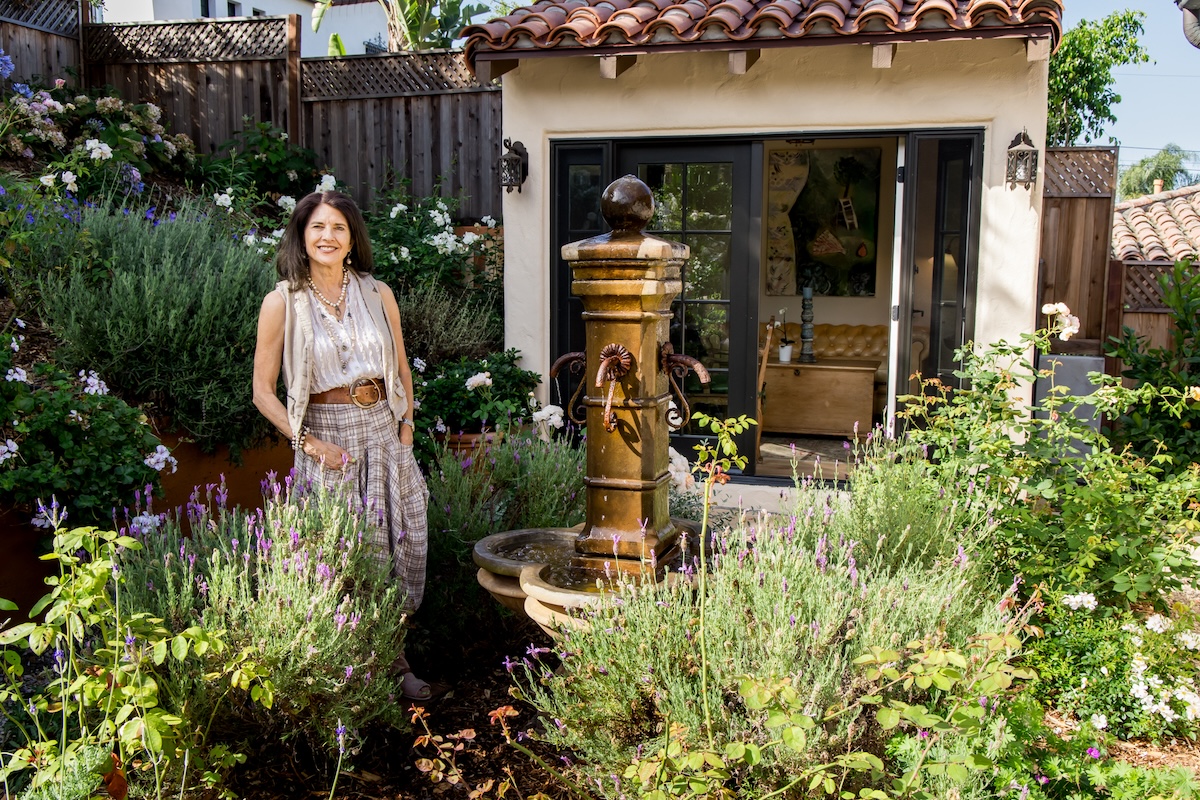
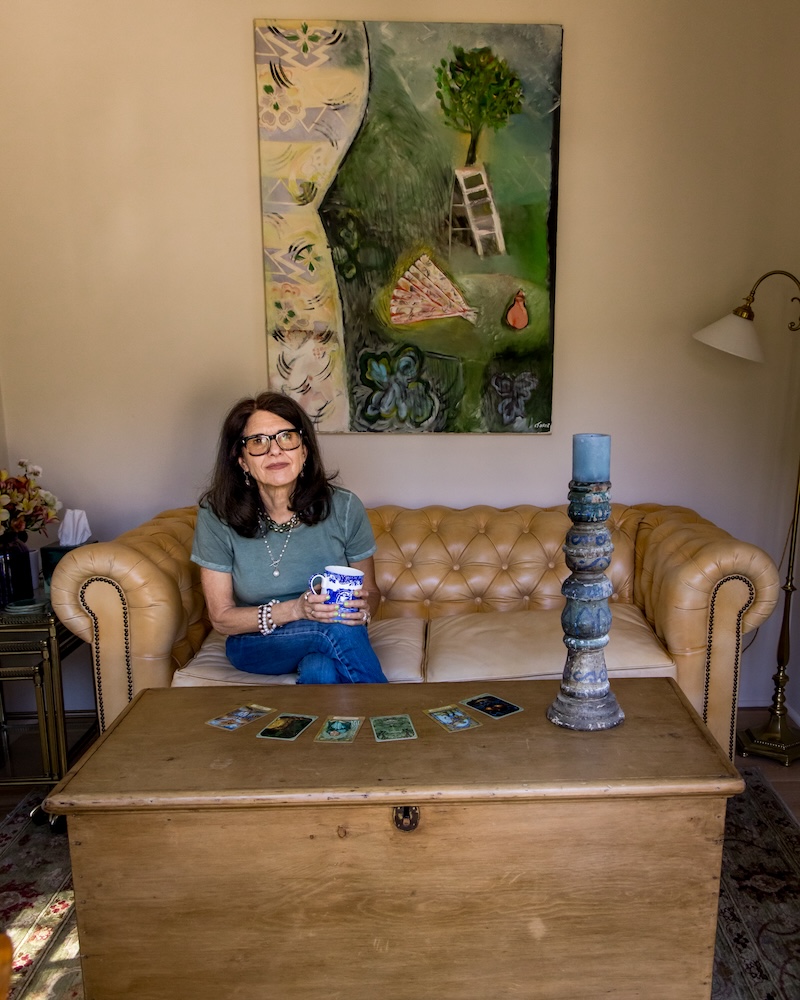
I was a bit wary prior to the session, afraid it’d fall into my clichéd idea of Tarot. I didn’t want to be told I was on a highway straight to Hades. But as we passed through her tranquil garden to her cozy office, a cup of freshly brewed loose leaf tea in hand, my fears dissipated. She instructed me to choose a few Tarot decks from her vast collection, then to blindly select a number of cards, arrange them in a pattern face down, and then freely assign words to them. After flipping them over, I’d examine the cards and see how they related to my chosen words and to see if the images related to the question I initially posed.
What sets Lauren apart is that she is not interested in explaining what the cards mean in the traditional Tarot sense. In fact, Lauren’s collection includes not only Tarot cards, but oracle cards, dream cards, soul cards, and any symbolic imagery because, as Lauren puts it, “when people pick their decks, it becomes much more specific to them – and the synchronicities are astounding.”
It’s not like typical Tarot. In fact, she strongly suggests not looking up the cards’ meaning at all, nor will she explain what they mean to her, unless you ask. She believes that images speak directly to the subconscious. She simply guides you: how do you interpret these images? What meaning do you derive from them?
“Images are one of the ways that we practice waking life. They are the language of the unconscious. We visualize, and then come in to practice our life. Tarotpy is like dreaming with your eyes open. The images are a mirror of what’s going on for us.”
In this way, Lauren says that Tarotpy acts as fast-tracked therapy. We may already have the answers to our questions, and by using images, we stimulate the imagination and quickly engage with the subconscious to find a creative solution spontaneously. As Lauren puts it, “we’re in a very deep conversation immediately. Tarot is not about doing parlor tricks or accurate predictions.” Rather, it’s a tool to help create order and peace in a chaotic world.
‘Tarotpy: It’s All in the Cards’
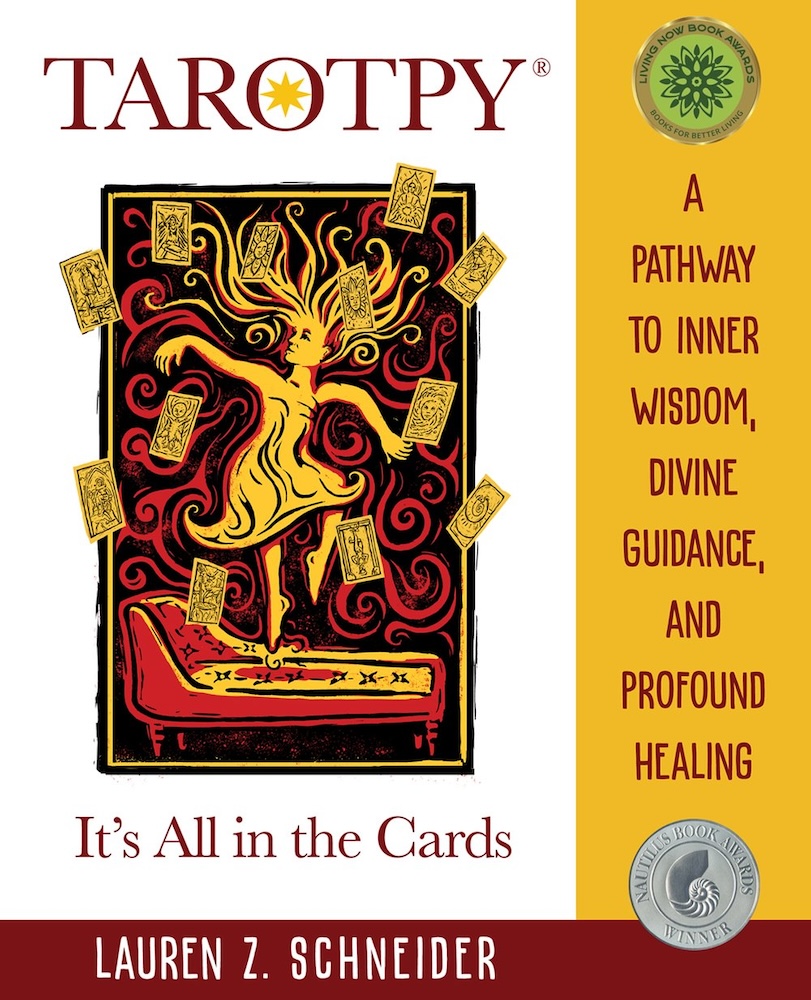
After our session, I read Lauren’s beautifully illustrated book, Tarotpy: It’s All in the Cards. In it, she recounts her own “Fool’s Journey,” as she puts it, from working in TV and film to being introduced to Tarot, and how she now incorporates this into her therapy practice. It’s an engaging, illuminating read, one that seeks to give counsel on how to bridge psychology and mysticism, how to bring soul back into our lives. It’s both practical and profound.
In the book, she also shares how you can use these enlivening techniques in your own life. This “interactive method of Tarotpy,” she writes, “accesses unconscious resources for insight and inspiration, unlocking creativity, problem-solving, and empowerment.” Full disclosure: I used Tarotpy to help with a bad case of writer’s block. Following the instructions laid out in Tarotpy, I went to my nearby metaphysical supply store, bought the Rider-Waite classic deck, and practiced her methods at home.
And it helped. Whether you believe in the divine power of Tarot or not, there is something to be said about challenging yourself to think outside the box and getting out of your comfort zone. I found that by engaging with these images in the way Lauren suggested sparked my creativity.
But there’s no denying that pulling a card that eerily speaks to a question you pose can be thrilling, if not mind boggling. As Lauren puts it, “It heightens something when we feel we are connected to something larger. Synchronicity is a nonrational experience that makes us feel connected to ourselves in a deeper way.”
Making the Connection
Though there is a clear secular aspect to how Lauren uses Tarot and her collection of decks, she does believe that there is indeed something divine that guides us, attempting to lead us to greater connection.
“I’m good at helping to reflect on these patterns that we’re noticing between the cards and ourselves. But the other aspect that I consider is that the universe is also an intelligent organized consciousness that is participating with us, and that it’s somehow bringing up exactly what we need.”
What is this organized consciousness? Who’s to say? But as writer Joseph Campbell has said, “If you are on the right path, you will find that invisible hands are helping.” Lauren too believes that the universe conspires to help us.
This aspect of being connected to something larger than ourselves is very important to Lauren, especially when it comes to existential questions like climate change and the state of our world. It’s why she believes the practice of Tarotpy can be used for such things as eco-therapy and realigning ourselves with the natural world. If we feel we’re connected to everything, our actions will reflect that, benefiting the collective and the planet, not just the individual. Lauren shares her thoughts:
“We’re in a huge transition and people are very anxious. We’re dealing with climate change, socio-political upheaval, and a digital age that often makes us feel disconnected. That’s why people are so hungry to integrate these divination tools. Your whole generation, and the generation after you, are really hungry for divination. They’re bringing together divine and ordinary. They’re bringing together science and mysticism.”
She’s right. There’s been a growing interest in alternative practices and the unexplained phenomena that deviate from science and the rational, especially with younger people. TikTok has even influenced the rise of Tarot. And take, for example, podcasts like Otherworld, created and hosted by Jack Wagner. Starting in 2022, the podcast has exploded in popularity, with a listenership that now reaches hundreds of thousands of monthly listeners. It’s been featured in the LA Times and the Washington Post, the latter calling it the “This American Life” for Gen Z, due to its first-person narration of people retelling experiences that go beyond the explainable.
I reached out to Jack for why he thinks young people are gravitating to these sorts of things:
“I think in the last decade young people have grown up witnessing everything from the failure of our largest institutions, the shutdown of society during a pandemic, and several things that used to be ‘conspiracy theories’ being revealed to be true. Growing up and living through things like this make people more open minded… There might be more to our lives and the world than we currently understand.”
Internet culture writer Joshua Citarella also affirms Lauren’s thoughts, writing: “In the past, mankind would look to scientific tools to… know the world. Our relationship to these profoundly complex tools of knowledge… have become much more similar to divine consultations with a medium or oracle. The process is unknowable and beyond our capacity for understanding. Strangely, our trust in rationality has become an act of faith in itself. As official narratives disintegrate, our curiosity naturally flows toward the great unsolved questions of the human experience.”
That’s where someone like Lauren comes in, a professional who not only has an extensive background in psychotherapy, but who also has, for decades, been studying alternative practices that seek to enliven our consciousness. She hasn’t tapped into the zeitgeist, the zeitgeist has tapped into her. She’s become a conduit between both worlds, the scientific and the mystical, with a mission to bridge connection. And her hope is that, whether it’s through her book Tarotpy, or through personal consultations and sessions, she can help people who are searching for that connection and enrichment of the soul.
“Synchronicity is something that I think is incredibly healing because you’re in a moment where everything connects. It’s a glitch in the matrix that breaks through our illusion of separation in which dreaming and waking, ourselves and the world, psyche and matter, are one. In that moment we feel whole.”
Lauren shared a quote with me by the psychologist James Hillman: “True healing requires a deep understanding of the interconnectedness of all things.” In such contentious, divided times like these, that quote rings truer than ever.
Thinking back on meeting Lauren, I can’t help but feel baffled and lucky that I randomly met this incredibly interesting, and highly accomplished woman while in line at the movies. It felt conspicuously on the nose. But some things just can’t be explained. Was the universe working in its mysterious way to help little insignificant me? It’s nice to think so.
Carl Sagan once wrote, “The universe seems neither benign nor hostile, merely indifferent.” But, what if Sagan was wrong? What if it’s conspiring to help us? I don’t know. Just a thought.
Tarotpy: It’s All in the Cards can be purchased locally at Chaucer’s or online at Amazon. Learn more about Lauren Schneider and her practice at her website dreamsandtarotpy.com
You might also be interested in...




You must be logged in to post a comment.