
The Settee and its History
My brother and sister-in-law live in a sophisticated New York high-rise close by the Dakota Apartments. They have a favorite breed of dog, and have cared for a string of Great Danes up there – suffering many elevator rides for pee breaks over the years. Lucy, their latest Dane, can be seen in the Central Park romp scene in the 2025 movie The Friend. Lucy is chasing the central dog character, the Harlequin Dane called Apollo. (Yes, there is a Dane Play Club in the Park!) Look closely and you’ll see Lucy in the trailer, from the movie starring Bill Murray and Naomi Watts. Watts plays a writer who adopts the Great Dane formerly belonging to Murray’s character, who was her friend and mentor. It’s poignant, because the dog grieves for his lost master. My brother Paul and Melissa identified with adopting a huge animal in downtown Manhattan, and with the theme of abrupt endings.
Lucy sadly passed away after the release of the film, and we all miss her 150 pounds and goofy expression. Like many treasured friends, the best ones sometimes have shorter life spans, and this is true of this noble breed, the Great Dane. Looking for a memorial for Lucy, I came across the Adopt-a-Bench program for New York’s Central Park Benches and Settees. This program, run by the Women’s Committee of the Central Park Conservancy, has provided funding for the Park’s 10,000 benches with 7,000 adopted benches for 64 million visitors a year.
This got me interested in the history of the settee – but first, a run-down of the three important New York Central Park outdoor settees. First, the 1939 World’s Fair bench; divided by distinctive hoop armrests shaped to echo the circular walking paths around the Park, painted in Central Park Green. Secondly, the straight-planked, slatted bench – which can be seen all along the Mall – was developed in 1858 when the park opened its first ice skating rink. More modern is the concrete and wood bench, which can be found around the park’s perimeter. All three styles are reproduced by Kenneth Lynch and Sons, NYC bench makers since the 1920s.
Where did the idea – one piece of seating furniture for multiple rear ends – even originate? That all began in the 10th century when a chest was one of the few pieces of furniture needed in a room. The chest could hold objects, was used as a seat and also as a table, and was convenient for frequent moves. Built-in church monastic settees adopted the design of the medieval household trunk or chest, and this led to the birth of the settee – which could be a seat, a bed, or (given its hinged back) a chest or table). The armrests could hold candlesticks or tankards, while shelves under the settee could house drawers or act as footrests. The height of the backrest varied and could sometimes continue down to the floor. In fact, the settee was often built into a wall or corner (when adjoining a fireplace, that warming alcove is called an ‘inglenook’).
By the 15th century, when the public house or inn/tavern was developed for travelers needing accommodation, the wooden settee incorporated shelf rests for drinks. By the 17th century, nailed-down leather added a little sitz-bones comfort, and chairmakers began to explore the settee as a household design – based not on the medieval chest, but on the Windsor chair with a canted back, shaped seats, and graceful arms. Country folks retained the tradition, and the rural parson or school master bench was popular into the 19th century, and was later adopted into the historical lexicon of the Colonial Look in the early to mid-20th century.
Back in Deerfield, Illinois, in the 1960s, my mother’s front room was ‘Colonial,’ (lots of Ethan Allen furniture) and we had a settee that was painted black with gold eagle stenciling.
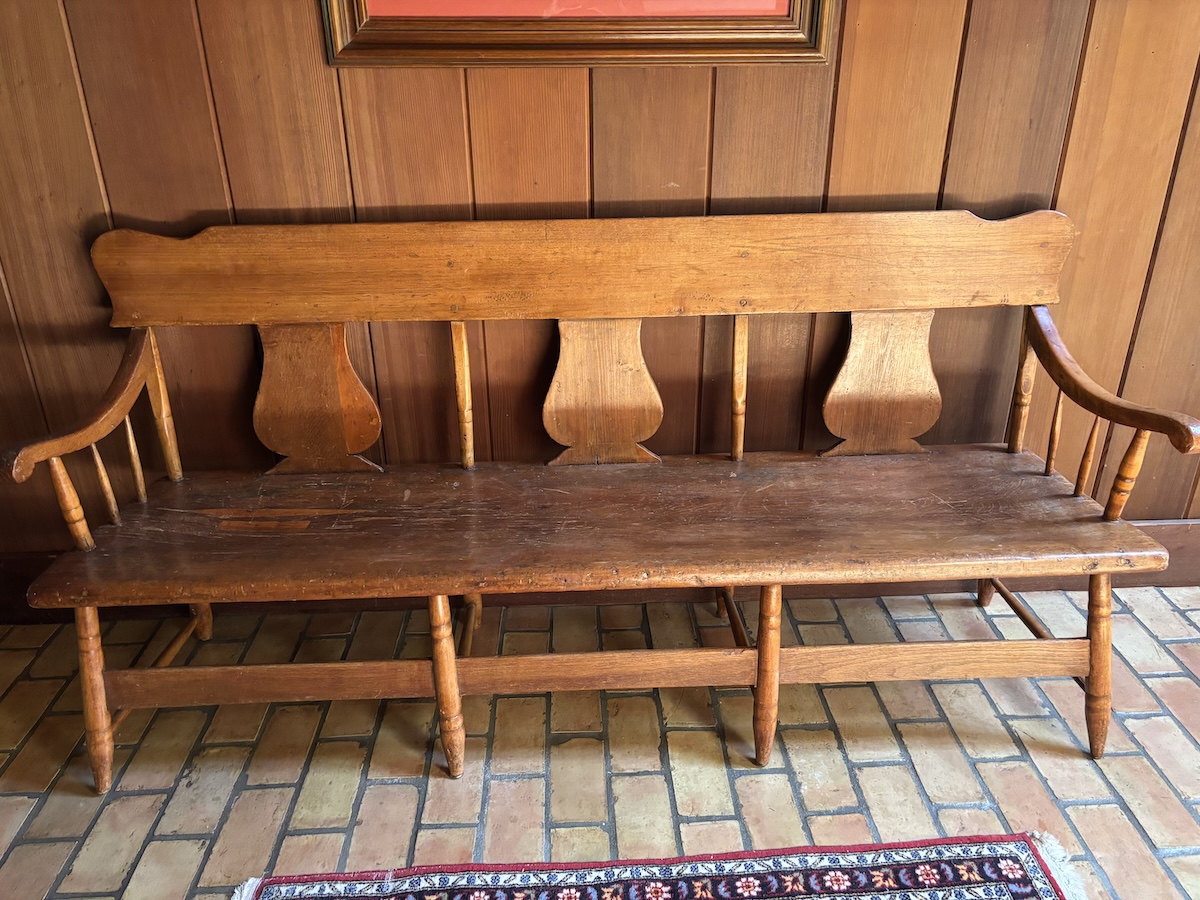
Mrs. S sends me a shot of her settee in the Sheraton Style American Transition; a form which emerged during the American Federal period of furniture design. Her New England settee from the first quarter of the 19th century is of fruitwood, (likely cherry or maple), with a shaped crest back rail supported on wide lyre-form splats. The settee has scrolled arms centering the single plank seat which is raised on eight turned legs joined by a box stretcher.
She has had it for years and wondered about the value. In this market where antiques are no longer as prized as they were 25 years ago, these simple, understated, unfrilly, plainspoken pieces of furniture are still desirable. A good Pennsylvania settee can command a price of $800-1,000.
You might also be interested in...



