
Santa Ynez Chumash Museum and Cultural Center Is Now Open!

The Santa Ynez Band of Chumash Indians’ (SYBCI) Chumash Museum and Cultural Center is now open to the public! Twenty years in the making, it is “A Legacy of Culture, Innovation, and Resilience.”
I attended the official grand opening held on May 15, where I met with the SYBCI Museum Board Chairwoman and Tribal Member Kathleen Marshall, Museum Director James Bier, and PR Media Manager Sean Larsen. They graciously spent an hour touring the museum with me in detail.
Along the sidewalk to the entrance, there is a continual mural titled, TIMELESS PAST. It is constructed of stone, commemorative tiles, and carvings of animals inlaid in pebble substrate. Bier explained, “It is a symbolic procession of culture, technology, ingenuity, craftsmanship, skill and accomplishments in the midst of regional natural history to help visitors understand the time depth of Chumash people in the area, and provide context for the stories in the museum. The timeline will meander along the entrance procession from the parking lot to the front door of the Welcome House, inviting visitors to join the Journey and discover elements along the way. The substrate of pebbles symbolically represents the Santa Ynez River – the life-giving force in the valley which sustained Chumash people since time immemorial.” At the museum entrance, visitors are greeted by a striking sculpture “Keeping our Culture Alive,”, by artist George Rivera.
The Welcome House is a large constructed tule ‘Ap – a traditional Chumash enclosure – with a 30’4” dome. Its double doors weigh 300 to 500 pounds. The rotunda-shaped interior has framed art of Chumash dancers, projected gold birds flying above the art and tribal nature sounds. On the floor is the Medicine Wheel with the Four Directions, seasons and elements, and a sunken fire pit under glass. Here we are transformed to a peaceful state. The hallway leading to the Permanent Collection features artwork replicating Chumash pictographs found in caves and on rock formations.
On entering the Permanent Collection, visitors are greeted with a blessing. The galleries depict the Chumash belief in the Lower, Middle, and Upper Worlds. Throughout are interactive displays and learning areas. For the Middle World, there are five SYBCI tribes chosen to be exhibited. Tribal lands and settlements became submerged under Chumash Lake when Bradbury dam was built in 1953. Another section is devoted to modern day culture.
There is a full spectrum display of handmade baskets. These public displays are rotated on a continuous basis for their preservation. The flagship is the Presentation Basket made by Maria Sebastiana Suatimehue at Mission San Buenaventura in the early 1800s. Only seven such baskets, created by Maria Sebastiana Suatimehue, Juana Basilia Sitmelelene, and Maria Marta Zaputimeu, exist in the world, and are otherwise found in private collections and international museums. The Santa Ynez Chumash Museum and Cultural Centermuseum is acquiring a second such rare basket.
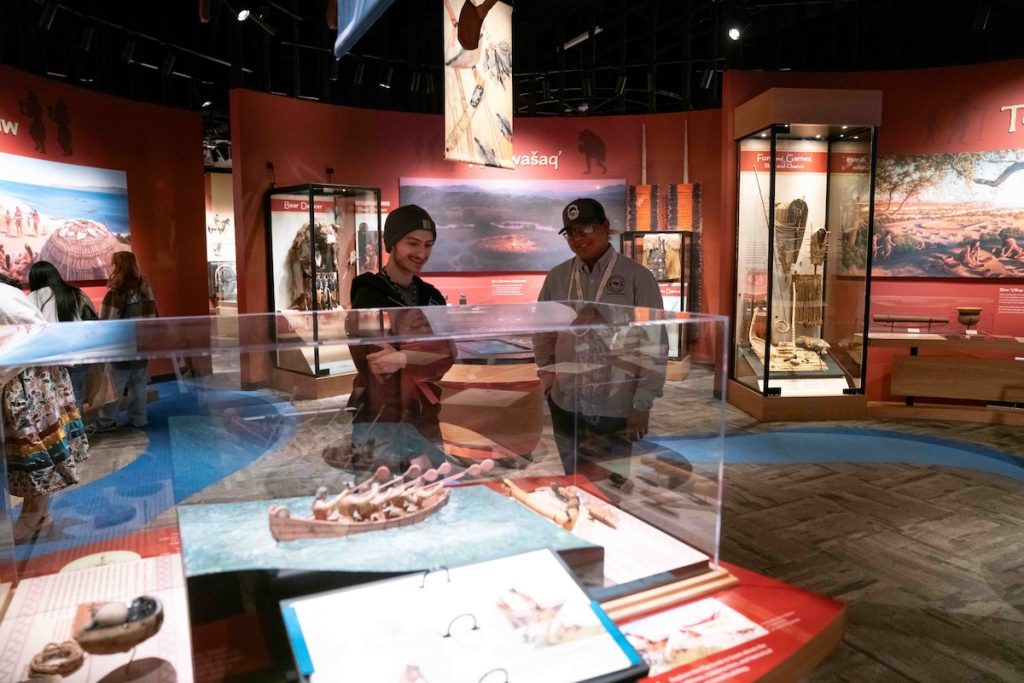
On view are musical instruments, tools, ceremonial costumes with headdresses like the “Bear Dancer,” arrowheads, feathers of significant birds, stone pottery, books, boats, animal skin bags, jewelry, art, and shell money. Items in the museum’s collection are from tribal members, the general public, collectors, institutions, commissioned artists, artisans, and through repatriation and cultural returns.
A taxidermy mount / tribute to the California Condor displays the last female condor living in the wild in 1986, before all 27 surviving condors were captured for safekeeping and captive breeding. The tribe acquired the taxidermy from the California Department of Fish and Wildlife.
The museum makes a tribute to the SYBCI native language, which goes by several names. Samala, Ineseño, and Ynezeño are all names for the language of the Santa Ynez Band of Chumash Indians. The museum also pays tribute to the keeper of their language and culture, Qilikutayiwit (María Ysidora del Refugio Solares), a longtime resident of Santa Ynez, born in April 1842.
Research shows Solares worked with linguist-anthropologist J. P. Harrington to record the Samala language, stories, and the names of village sites. Harrington was employed by the Smithsonian Institution and worked to preserve the languages of Native California. He started with the Chumash language in 1912, and worked with Solares from 1914 for five years. The sheafs of his handwritten field notes, files, photographs, maps, and drawings were unorganized and stored in boxes at the Smithsonian. Decades later, UC Berkley linguist grad student, Dr. Richard Applegate, went through Harrington’s boxes to write his dissertation. Next, Applegate worked with the SYBCI, providing Harrington-Solares’s data and teaching the Samala language to tribal members.
The SYBCI has certified teachers of Samala. Tribal Member Kathleen Marshall is one of them. She shared with me that Solares is her great-great-great-great grandmother. At the museum, there is a replica of a tule ‘Ap where visitors can sit and learn Samala via A/V projection.
At the end of the permanent collection is a modern gallery where exhibits will rotate every two to six months. There is a 3.5-acre park with a work-in-progress Chumash traditional tule ‘Ap home, the Ancestors’ Grove (where there are oak trees and commemorative family stones paying homage and tribute to tribal ancestors), a Tomol House for the ceremonial Tomol boat named Muptamai (“Deep Memories”), and Chumash plants tagged with their taxonomic species name. The Gift Shop has items made by Santa Ynez Chumash Community Members and Indigenous artisans.
Architect Johnpaul Jones, whose portfolio includes the Washington, D.C. Smithsonian National Museum of the American Indian, designed the buildings to be oriented to the west to represent the Chumash culture as the Guardians of the West Gate – Humqaq, a sacred place, which is Point Conception.
The museum won a LEED® Silver Certification from the U.S. Green Building Council for its environmentally sound design, construction, and operational practices; and a water conservation award at the U.S. Green Building Council 13th Annual Sustainable Innovation Awards in L.A.
My take… Going to this museum is going on a journey into a timeless space, I highly recommend it for all ages.
You might also be interested in...




You must be logged in to post a comment.